First, what “work” could mean
Most arguments about posture correctors go nowhere because people mean different things. It helps to separate four possible outcomes, because the evidence is very different for each.
- While wornDoes your position change while the product is on? Often, yes.
- AwarenessDo you notice your position more? Plausible, and the main aim of feedback devices.
- After removalDoes the change last once you stop? Rarely tested; not convincingly shown.
- Pain and healthLess pain, fewer problems? Mixed, short-term and mostly small studies.
The evidence, sorted by what was actually studied
| What was tested | What it found | Why it’s limited | |
|---|---|---|---|
| Wearable posture devices (systematic review, 2026) | Randomised and quasi-experimental studies of wearables for posture | Potentially useful as a complement to physiotherapy | Short follow-up, small samples, limited blinding; evidence insufficient for firm recommendations |
| Upper-back vibration trainer (surgeons, 2024) | Eight surgeons, randomised to vibration feedback or an education workshop, 100 procedures | Less time in high-risk postures with vibration feedback during surgery | Tiny, specialised group; no evidence of lasting habits or pain prevention |
| Upper-back vibration trainer (Parkinson’s pilot, 2022) | 25 participants in the lab, 12 in a short home phase | Less neck flexion while sitting and standing with the device | No change in trunk or low back, and none while walking; clinical population, brief exposure |
| Seated lumbar strap (2019) | 21 enrolled, 18 analysed, 14 days, no control group | Less pain while using the support | Pain without the device on day 15 wasn’t significantly better |
| Elastic posture garment (computer users, 2016) | 96 volunteers, four weeks, before-and-after | Some self-reported and measured improvements | No parallel control group; funded by the manufacturer |
| Scapular bracing garment (athletes, 2013) | 38 healthy overhead athletes, strap tension vs no tension, in the lab | Smaller forward-shoulder angle with tensioned straps; muscle effects small and inconsistent | Acute lab effects in athletes don’t predict everyday long-term results |
Read down the right-hand column and a pattern appears: small groups, short periods and few comparisons against doing nothing. That doesn’t mean correctors are useless. It means the honest claim is modest: they can help you notice, and they can change your position while you use them.
What physical therapists suggest
HSS guidance, written with a physical therapist, treats correctors as a way to build awareness of your position, not a cure. It suggests wearing one for a few hours a day at most, alongside exercises that strengthen your own posture muscles, and planning to stop eventually: closer to training wheels than a permanent fix. It also notes there’s no data showing which type works best.
- Comfort first. If it isn’t comfortable, you won’t wear it, and a reminder you don’t wear does nothing.
- Target the right area. Shoulders, upper back and lower back need different products; a physical therapist can help.
- Use it as a prompt, not a crutch. The goal is for your own muscles to do the work.
- A prescribed brace is different. If a clinician gave you one, follow their advice, not a product listing.
Where that leaves a reminder like POIS
If the most supportable benefit of a corrector is noticing, it’s fair to ask whether you need something pressing on your body at all. A reminder delivers the noticing part without the strap: it tells you when your head has drifted and leaves the adjusting to you. It won’t hold anything in place, and nobody (including us) can promise it will change your posture permanently. But it’s comfortable enough to use all day, which is more than most braces can say.
The noticing, without the strap
Comfortable all day
It runs on the AirPods you already wear. Nothing under your arms, nothing across your back.
Speaks at the right moment
Quick glances pass in silence. You hear one quiet sound only when your head stays down.
Leaves the work to you
You notice, you adjust, you carry on. No device holding you in place.
Honest about its scope
It senses head orientation, not your spine, and it isn’t a medical device. It’s a way to notice.
Hear the whole idea in one sound
POIS plays this sound in your AirPods when your head stays tilted down compared with your natural position. That’s the entire intervention.
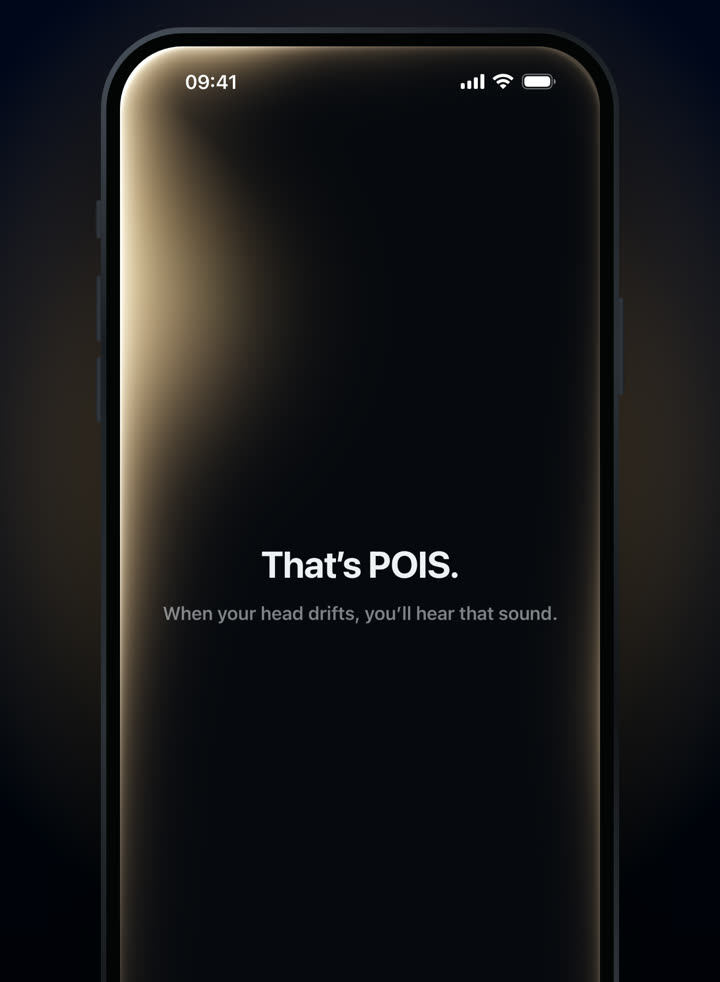
The shipping app, introducing its sound.
3-day free trial · Monthly or yearly, in your local price on the App Store.
Needs compatible AirPods and an iPhone with iOS 18 or later. Screens from the shipping app.
General information, not medical advice. If you have pain, numbness or a diagnosed condition, talk to a qualified professional. POIS isn’t a medical device and doesn’t diagnose, treat or prevent any condition.